🔥 LIMITED-TIME GRAND OPENING OFFER · FREE STANDARD SHIPPING · DUTIES & TAXES INCLUDED

Car Screen Protector Size: 5 Easy Fitment Checks

Last reviewed: August 2026
Choosing the right car screen protector size starts with matching the protector to the physical screen in your vehicle—not just the model name.
Before ordering, check the exact vehicle variant, model year or generation, display size, screen shape and vehicle configuration. Then compare those details with the fitment information on the product page.
If anything does not match, keep the protective liner in place and ask for help before installing the glass. A clear, front-facing photo is often more useful than another guess.
Why the Vehicle Name Is Only the Starting Point
Model names can remain the same while the interior display changes. Different versions may use different screen sizes, aspect ratios, bezel designs or corner shapes.
These differences matter because a tempered-glass protector is cut for a specific physical screen. The wrong product may sit on the surrounding trim, leave an uneven gap, cover part of the display or fail to match the corners.
Start with the model name, but do not use it as the only fitment check.
Five Easy Checks for the Right Car Screen Protector Size
| Check | What to record | Why it matters |
|---|---|---|
| 1. Vehicle and variant | Brand, full model name and trim | Different versions may use different interior equipment. |
| 2. Model year or generation | Model year, generation, facelift or refresh | The display can change during a model’s production run. |
| 3. Physical display size | Diagonal size plus approximate glass width and height | A similar diagonal does not guarantee the same proportions. |
| 4. Orientation and shape | Landscape or portrait, corners and bezel shape | The protector must match the complete front glass. |
| 5. Vehicle configuration and market | Trim, equipment and original sales market | Names and specifications can vary between regions. |
Together, these checks help you compare the listed car screen protector size with the physical display in your vehicle.
1. Confirm the Exact Vehicle and Variant
Start with the full vehicle name shown in the vehicle settings, official app, purchase documents or owner’s manual. Add the trim or variant whenever possible.
A product listing that names only a model and year may not provide enough information to confirm fitment. Look for details about the exact display configuration.
2. Check the Model Year and Generation
The registration year and model year are not always the same. Delivery timing and regional naming can also affect how a vehicle is described.
If a product page mentions a generation, facelift, refresh or production period, compare that information with your vehicle before ordering.
3. Look Beyond the Advertised Diagonal
The advertised screen size usually describes a diagonal class. It does not fully describe the protector’s width, height or outer shape.
Two displays with a similar diagonal can still have different:
- widths and heights;
- aspect ratios;
- visible-display borders;
- corner radii;
- front-glass dimensions; and
- surrounding bezels or trim.
It also helps to distinguish the illuminated display area from the complete front glass. For general measuring guidance, see 3M’s screen-measuring guide.
The diagonal is useful for identification, but it is not a complete fitment specification on its own.
4. Match the Orientation, Shape and Number of Screens
Check whether the display is landscape or portrait. Look at the complete outline of the front glass, including rounded corners, asymmetrical sections and connected panels.
Also check what the product covers. A vehicle may have a centre display, instrument display and passenger display, while a particular protector may cover only one of them.
5. Check the Vehicle Market and Configuration
Vehicle names and trim descriptions can vary between the United States, Canada, the United Kingdom, Australia and other markets. Use the original sales market together with the physical display, model year and vehicle configuration when checking fitment.
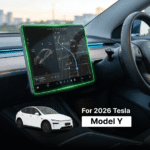
For Tesla Model Y owners, our Tesla Model Y screen size guide explains how to distinguish 15.4-inch and 16-inch displays.
How to Measure the Display for Identification
You do not need to create a manufacturing template at home. The goal is to collect enough information to identify the correct screen configuration.
- Park the vehicle safely in a clean, stable location.
- Take a straight-on photo showing the complete display and surrounding trim.
- Note the advertised diagonal from official vehicle information, if available.
- Measure the approximate width and height of the relevant front-glass area in millimetres.
- Label what you measured: the illuminated display, the flat front glass or the bezel opening.
- Compare the proportions, corners and overall shape with the product-page images.
Use in-vehicle measurements as a cross-check. They should not override a clear incompatibility notice on a model-specific product page.
A Good Fitment Photo Can Save Guesswork
A useful fitment photo should be:
- taken straight on rather than from a steep angle;
- sharp and evenly lit;
- wide enough to show the complete display and nearby trim;
- free from hands, cables or strong reflections covering an edge; and
- accompanied by the model, year, variant and original sales market.
Before sending a photo, hide personal information such as addresses, recent destinations, contact names and account details.
Why the Right Car Screen Protector Size May Leave a Small Border
A narrow and even border does not automatically mean the protector is the wrong size. Some protectors leave a small clearance around the edge to account for the glass shape and surrounding trim.
Always compare the result with the fitment notes and product images for the exact protector. A narrow, even inset is different from a large or uneven gap.
Signs That the Protector May Not Fit
Keep the liner and packaging intact and ask for help if:
- the protector extends beyond the flat glass;
- an edge rests on the surrounding trim;
- the orientation does not match;
- the corner shapes are visibly different;
- the protector would cover part of the active display;
- a cutout or sensor position does not align;
- the product page names a different display size or generation; or
- the gap is much larger or more uneven than described.
Do not remove the adhesive liner just to test an uncertain fit. Contact the seller before installation.
A 60-Second Fitment Checklist
- ☐ Exact vehicle model and variant
- ☐ Model year and generation
- ☐ Display diagonal or named size
- ☐ Approximate front-glass width and height
- ☐ Landscape or portrait orientation
- ☐ Corner and bezel shape
- ☐ Number of screens covered
- ☐ Vehicle configuration and original sales market
- ☐ Package contents and installation method
Frequently Asked Questions
Is measuring the diagonal enough?
No. The diagonal helps identify the display, but it does not confirm the width, height, aspect ratio, glass outline, corner shape or bezel.
Can two displays with the same advertised size need different protectors?
Yes. Similar diagonal sizes can have different proportions and front-glass shapes. Always confirm the exact display configuration.
Should I measure the illuminated display or the full glass?
Record both when possible and label them clearly. Follow the measurement diagram and fitment notes on the exact product page.
What if my EV was privately imported?
Confirm the vehicle’s original sales market, physical display and configuration before ordering. Send a front-facing photo if you are unsure.
What should I do if the protector looks wrong before installation?
Keep the liner and packaging intact and contact the seller with clear photos. Do not apply the protector while compatibility is unresolved.
Ready to Check Your Screen Protector Size?
Before ordering, confirm your vehicle model, display size, screen shape and configuration. If you are still unsure, send Autolind a clear front-facing photo of your display and your vehicle details.
Contact Autolind for a fitment check or browse our current screen protector collection.
Autolind is an independent automotive-accessories brand and is not affiliated with, endorsed by or sponsored by Tesla, Inc.